

Last updated: August 12, 2026
Quick Answer: Korean language learning for beginners trips up most students in the same 9 predictable ways – from skipping Hangul to ignoring speech levels. The good news: a focused 20-minute daily routine, structured around the right lessons and a solid unit-by-unit plan, fixes nearly all of them faster than you’d expect.
Key Takeaways:
- Most beginners can read the Korean alphabet (Hangul) within 1-2 hours of focused practice
- Korean grammar follows Subject-Object-Verb order, the opposite of a typical English sentence
- Korean verbs change form based on tense and speech level – not just conjugation
- A 20-minute daily session beats a 3-hour weekend cram every single time
- Free apps and structured online courses make it possible to learn Korean entirely on your own
- Korean numbers use two separate systems – mixing them up is one of the most common beginner errors
- Speech levels (formal vs. casual) matter more in Korean than in almost any other language beginners study
- Consistent exposure to native Korean audio breaks the “they speak too fast” plateau quickly
Why Korean Language Learning for Beginners Goes Wrong So Fast
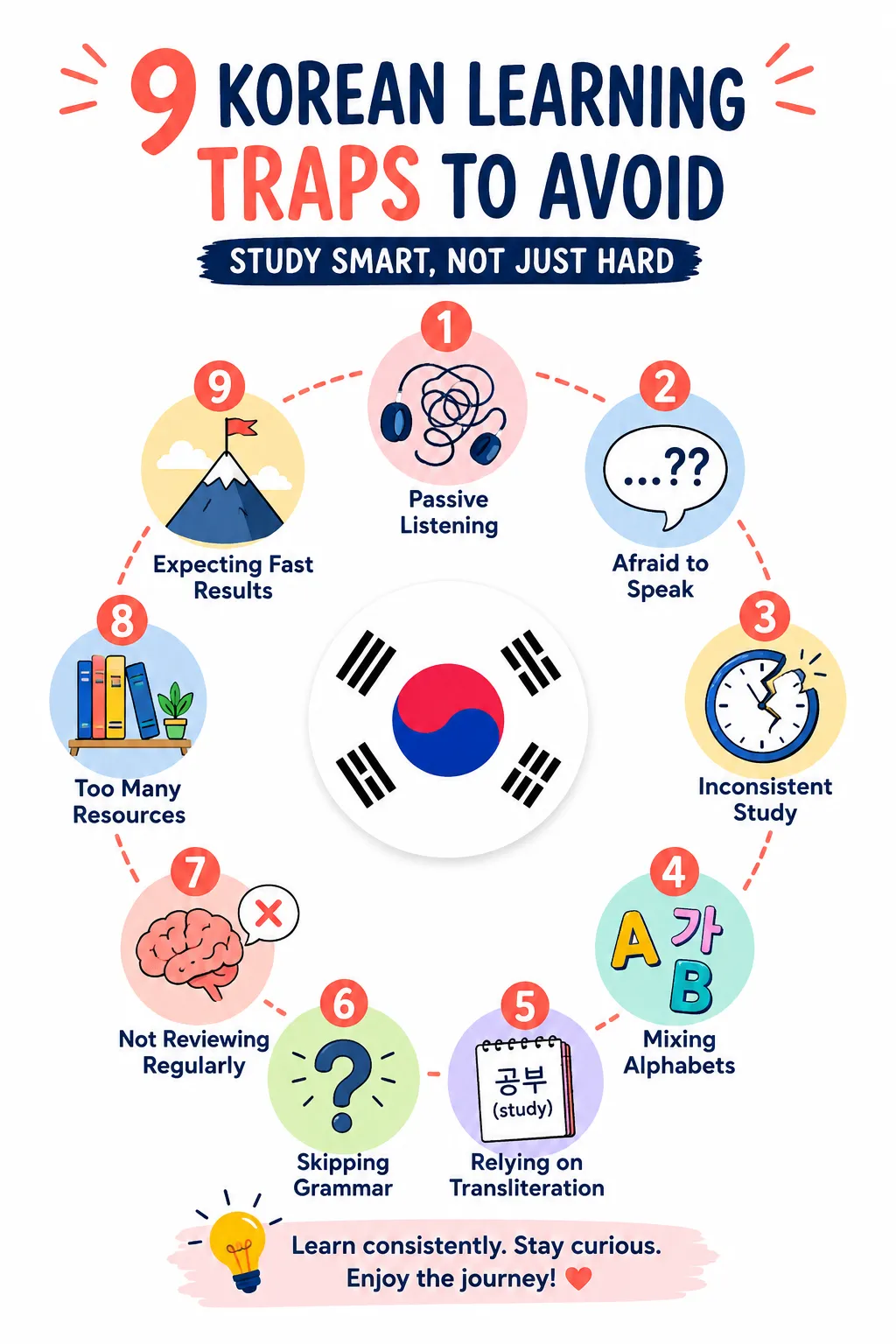
Most people who start learning Korean hit a wall within the first two weeks. It’s not because Korean is impossibly hard – it’s because beginners make the same 9 mistakes in the same order, and nobody warns them upfront.
Korean language learning for beginners is actually more structured than it feels at first. The language has clear rules, a logical alphabet, and a grammar system that rewards patience. The traps aren’t in the language itself – they’re in how people approach it.
Here are the 9 traps, and the 20-minute daily fix for each one.
What’s your language learning style?
Answer 6 quick questions — get a personalized study path built for how you actually learn.
Trap 1: Skipping the Korean Alphabet – Hangul
The trap: Jumping straight to phrases using romanized pronunciation (like “annyeonghaseyo”) instead of learning Hangul first.
Hangul is the Korean alphabet, and it’s genuinely one of the most logical writing systems ever created. According to the Korean Language Institute, most motivated beginners can read Hangul within 90 minutes to 2 hours of focused study. It has 14 basic consonants and 10 basic vowels, and the letters in Hangul combine into syllable blocks rather than running left to right like English letters.
The fix: Spend your first two 20-minute lessons on nothing but Hangul. Use a single unit focused on consonants, then one unit on vowels. Don’t move forward until you can read basic syllable blocks aloud.
Trap 2: Ignoring Korean Sentence Structure
The trap: Assuming a typical Korean sentence works like a typical English sentence.
A typical English sentence follows Subject-Verb-Object order: “I eat rice.” A typical Korean sentence flips the verb to the end: “I rice eat” (저는 밥을 먹어요). This isn’t just a grammar quirk – it changes how you build every single sentence you’ll ever say.
The fix: In your grammar unit, practice reordering English sentences into Korean word order before you translate anything. Write 5 Korean sentence examples per session. After each unit, do the graded quiz to test whether the structure is sticking.
Trap 3: Confusing Korean Numbers
The trap: Not realizing Korean uses two completely separate number systems.
Korean numbers come in two types: Sino-Korean (borrowed from Chinese, used for dates, money, minutes, phone numbers) and native Korean (used for counting objects, age, hours). Mixing them up is one of the most embarrassing errors a beginner can make – like saying “I am thirty minutes old” instead of “I am thirty years old.”
The fix: Dedicate one full unit to each system. Learn Sino-Korean numbers (일, 이, 삼…) and native Korean numbers (하나, 둘, 셋…) in separate sessions. Use them in sentence examples so context becomes automatic.
💡 Quick reference – Korean numbers 1-10:
- Sino-Korean: 일(1), 이(2), 삼(3), 사(4), 오(5), 육(6), 칠(7), 팔(8), 구(9), 십(10)
- Native Korean: 하나, 둘, 셋, 넷, 다섯, 여섯, 일곱, 여덟, 아홉, 열
Trap 4: Treating Korean Verbs Like English Verbs
The trap: Applying English verb logic to Korean verbs.
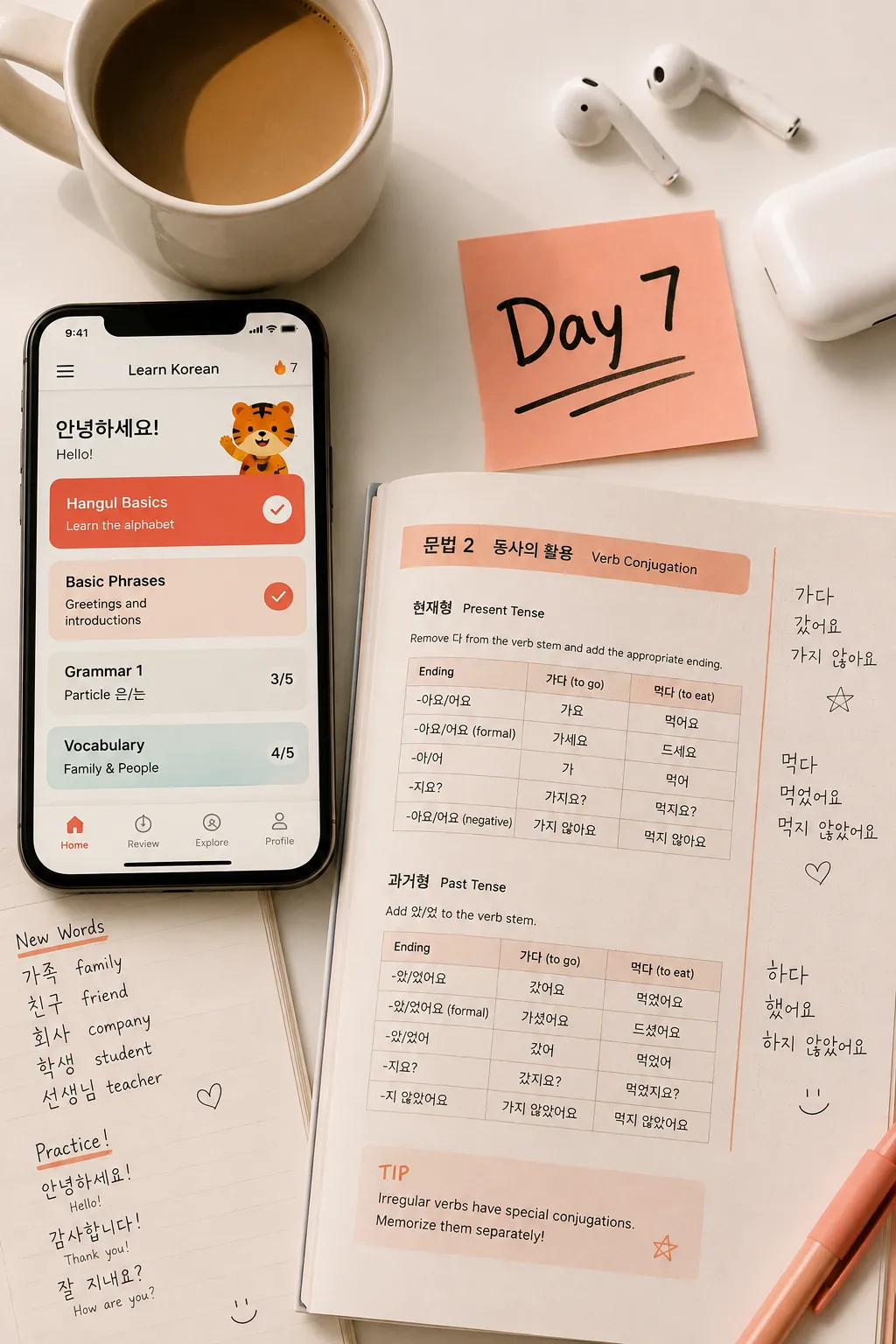
Korean verbs always go at the end of a sentence, they conjugate based on tense AND speech level, and many common verbs use the 하다 (hada) construction. Korean verb conjugation follows specific vowel-harmony rules – for example, present tense uses 아요/어요/여요 endings depending on the verb stem’s final vowel. Past tense adds 았어요/었어요/였어요, and Korean future tense uses the (으)ㄹ 거예요 construction.
The fix: Build a verb notebook. Each day, take 3 common verbs and conjugate them across all three tenses. After your lecture notes, do a timed quiz – even 5 minutes of quiz practice per session locks in verb patterns fast.
Common Mistakes Beginners Make Learning Korean (Traps 5-9)
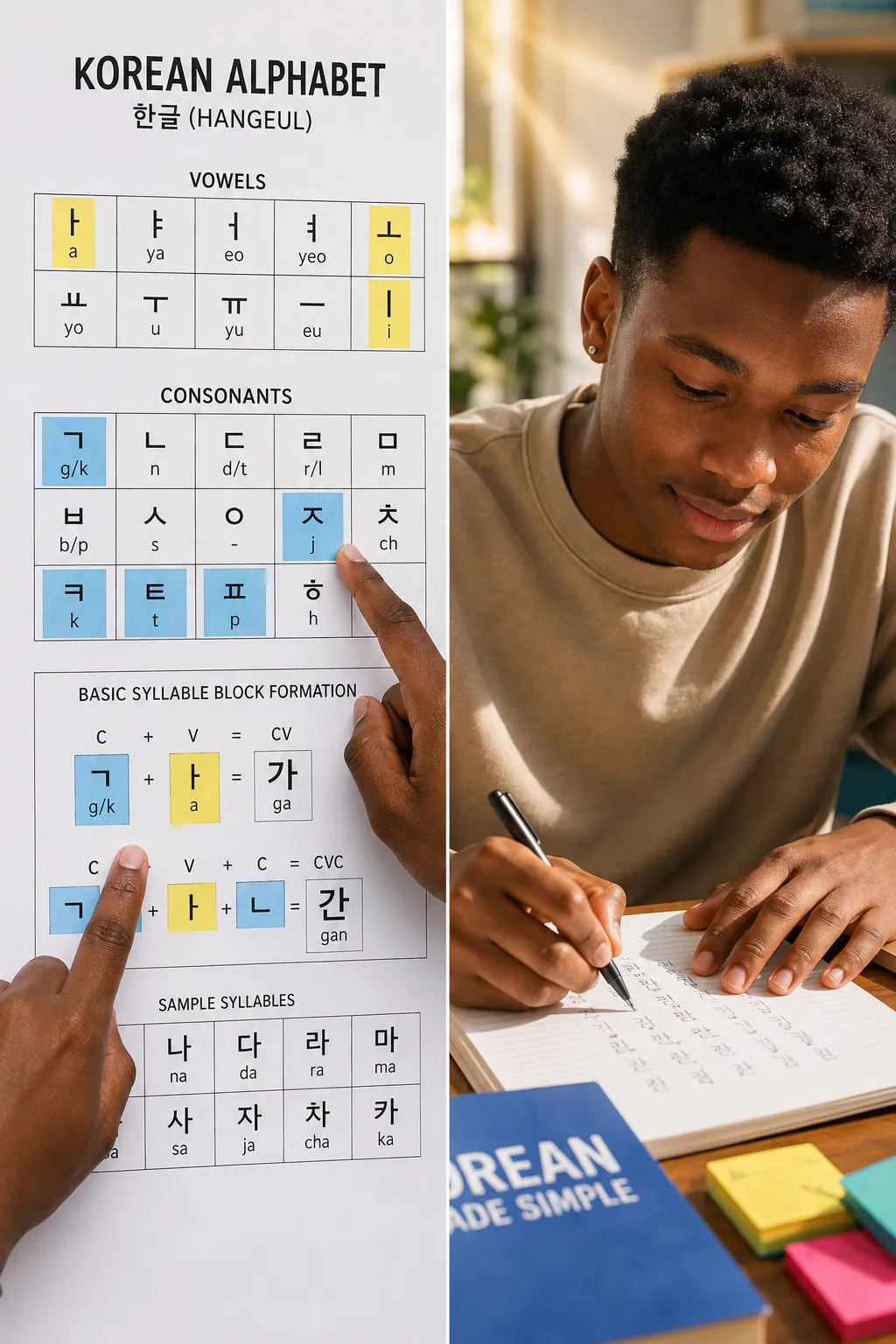
These next five traps are subtler but just as damaging to your progress. Most learners only notice them after weeks of frustration.
Trap 5: Skipping Korean Particles
The trap: Ignoring particles because they have no English equivalent.
Korean uses particles (small syllables attached to nouns) to show the grammatical role of each word in a sentence. Common particles include 은/는 (topic marker), 이/가 (subject marker), 을/를 (object marker), and 에 (location/time marker). Without particles, your Korean sentence sounds like a random list of words.
The fix: In each grammar unit, identify the particles used and say them aloud in a full sentence. Don’t just read the lecture notes – use the graded quiz at the end of each module to test particle recognition.
Trap 6: Ignoring Speech Levels
The trap: Learning only one speech level and sounding either rude or robotic in every conversation.
Korean has 3 common speech levels beginners need to know: formal polite (합쇼체), informal polite (해요체), and casual (해체). Most Korean lessons for beginners start with informal polite, which is safe for most situations. But using casual speech with a stranger or formal speech with a close friend creates real social awkwardness.
The fix: Learn which speech level each lesson targets. After completing a module on speech levels, practice the same sentence in all three forms. This single habit will make your Korean sound natural faster than almost anything else.
Trap 7: Avoiding Korean Adjectives and Adverbs
The trap: Building vocabulary only around nouns and verbs, leaving adjectives and adverbs for “later.”
Korean adjectives actually function as verbs – they conjugate just like action verbs do. Common adjectives like 크다 (to be big) or 예쁘다 (to be pretty) follow the same conjugation rules as Korean verbs. Korean adverbs, on the other hand, don’t conjugate at all – common adverbs like 빨리 (quickly) and 많이 (a lot) stay the same regardless of tense. Adverbs that modify adjectives work the same way in Korean as in English, which is one of the easier grammar points to learn.
The fix: Add 2 adjectives and 2 adverbs to your vocabulary list each session. Use them in a sentence example immediately – don’t just memorize the definition.
Trap 8: Never Listening to Native Korean Speakers
The trap: Studying only written Korean and then being completely lost when you hear native Korean speech.
Native Korean speakers speak at a natural pace that sounds incredibly fast to beginners. This is partly because Korean uses a lot of contracted forms in speech that don’t appear in textbooks. The “they speak too fast” feeling is almost universal among beginners – and it only goes away with consistent listening practice.
The fix: Use 5 of your 20 daily minutes for pure listening. Watch a short Korean clip, a drama scene, or a YouTube lesson without subtitles first, then with. After about 30 days of this, the speed starts to feel normal. For a structured approach to building this habit, the How to Learn Korean Language Step by Step guide breaks this into a clear daily plan.
Trap 9: Studying Without a Structured Course or Unit Plan
The trap: Jumping between random YouTube videos, apps, and phrasebooks with no consistent unit-by-unit progression.
This is the biggest trap of all. Without a structured course, you end up with gaps – you know how to say “I love Korean food” but can’t ask where the bathroom is. A proper course moves you through units in a logical order: alphabet, numbers, basic sentence structure, particles, verbs, adjectives, speech levels.
The fix: Follow a course that shows you total minutes per lecture, includes lecture notes you can review, and ends each unit with a graded quiz. If you want a structured program that covers all of this with audio lessons and a free trial, Rocket Languages offers a Korean course with interactive lessons, graded quizzes, and a certificate track – and you can start with a free trial to test it before committing.
Can You Learn Korean in 20 Minutes a Day?
Yes – 20 minutes of focused daily practice beats longer, irregular sessions for language learning. Research on spaced repetition consistently shows that shorter, daily exposure builds stronger memory retention than cramming. The key is structure: each 20-minute session should have a clear goal – one lecture, one quiz, one set of verb conjugations, or one listening exercise.
Here’s a sample 20-minute daily plan:
| Time | Activity |
|---|---|
| 0-5 min | Review previous unit’s lecture notes |
| 5-12 min | New lesson content (grammar or vocabulary) |
| 12-17 min | Graded quiz or sentence writing practice |
| 17-20 min | Listening to native Korean audio |
This structure works whether you’re using a formal course, a free app, or a combination of both. The total minutes add up fast – 20 minutes daily equals over 120 hours per year.
How Long Does It Actually Take to Learn Korean as a Beginner?
The Foreign Service Institute (FSI) classifies Korean as a Category IV language for English speakers, estimating approximately 2,200 class hours to reach professional working proficiency. For conversational fluency, most motivated beginners reach a comfortable level in 12-18 months of consistent daily study.
That said, “learning Korean” means different things at different stages:
- Reading Hangul: 1-2 hours
- Basic survival phrases: 1-2 weeks
- Hold a simple conversation: 3-6 months
- Watch Korean dramas without subtitles: 1-2 years
The 20-minute daily fix won’t get you to fluency in a month. But it will get you further in 6 months than most people get in 2 years of casual study.
Is Korean Grammar Harder Than English Grammar?
Korean grammar is different from English grammar, but not necessarily harder – it’s just unfamiliar. The biggest adjustments for English speakers are: verb-final sentence structure, particles with no English equivalent, and verb conjugation that encodes politeness level.
On the other hand, Korean grammar has some genuinely easier features: no grammatical gender, no articles (no “a” or “the”), and very regular conjugation patterns once you learn the rules.
For a comparison of how Korean stacks up against other languages you might be considering, check out our language-specific lessons section for structured breakdowns.
Korean Language Learning vs. Japanese: Which Is Easier?
For English speakers, Korean is generally considered slightly easier than Japanese. Japanese requires learning three separate writing systems (Hiragana, Katakana, and Kanji), while Korean uses only Hangul – a single, learnable alphabet. Korean grammar and Japanese grammar are structurally very similar (both are SOV languages with particles), so if you know one, the other becomes faster to pick up.
That said, both languages are in the FSI’s hardest category for English speakers. The “easier” one is whichever you’re more motivated to learn.
Best Free Apps and Methods to Learn Korean for Beginners
The best free tools for Korean language learning for beginners combine structured lessons with audio practice. Here are the most effective options in 2026:
- Duolingo Korean – Good for daily habit building, weak on grammar depth
- TTMIK (Talk to Me in Korean) – Excellent free podcast lessons and lecture notes, strong grammar unit coverage
- Anki – Best for vocabulary flashcards with spaced repetition
- Naver Dictionary – Essential free tool for looking up Korean words with example sentences
- YouTube (Korean Unnie, Professor Oh) – Free video lessons covering everything from Hangul to advanced verb conjugation
For a more complete step-by-step roadmap on combining these tools, see our guide on how to learn Korean language step by step.
If you want a single platform that covers all the bases – audio lessons, graded quizzes, certificate tracking, and structured units – Rocket Languages Korean is worth a look, especially since they offer a free trial so you can test the full course before paying anything.
What’s your language learning style?
Answer 6 quick questions — get a personalized study path built for how you actually learn.
How to Stop Sounding Like a Textbook When Speaking Korean
Sounding natural in Korean comes down to three things: using contractions in speech, matching your speech level to the situation, and listening to enough native Korean to absorb natural rhythm.
Textbook Korean often teaches full, formal sentences that native Korean speakers rarely use in casual conversation. For example, textbooks teach “저는 학생입니다” (I am a student – formal), but in everyday speech you’d more likely hear “저 학생이에요” or even just “학생이에요.”
Practical fixes:
- After each lesson, find the same phrase used in a Korean drama or YouTube clip
- Practice saying sentences aloud, not just reading them
- Use the informal polite speech level (해요체) as your default until you’re comfortable
- Get a language exchange partner through apps like HelloTalk or Tandem
For more on building natural fluency habits, the same principles that work for Spanish language learning apply directly to Korean – consistent output practice matters as much as input.
How to Break Through the Korean Learning Plateau
Most beginners hit a plateau around the 3-6 month mark. Progress feels slow, new vocabulary isn’t sticking, and Korean still sounds fast. This is normal – and it’s a sign you need to change your input, not your effort level.
Plateau-breaking strategies:
- Switch from studying Korean about Korean to consuming Korean in Korean (dramas, podcasts, webtoons)
- Start a graded reading program – Korean graded readers exist at beginner and intermediate levels
- Focus one full week on a single grammar point you’ve been avoiding (usually verb conjugation or particles)
- Find a native Korean speaker for a weekly 30-minute conversation exchange
- Track total minutes studied per week – sometimes the plateau is just inconsistency in disguise
The plateau isn’t failure. It’s the point where passive knowledge starts converting to active skill. Push through it with more output, not just more input.

Embarking on Your Korean Learning Journey: A Beginner’s Roadmap
Starting Korean language learning for beginners doesn’t have to be overwhelming. Break the journey into clear stages, and each unit feels manageable.
Stage 1 – Foundation (Weeks 1-2):
- Learn the Korean alphabet (Hangul) – consonants and vowels
- Practice reading syllable blocks aloud
- Learn Korean numbers (both systems)
- Complete a graded quiz after each unit to check retention
Stage 2 – Basic Communication (Weeks 3-8):
- Study Korean phrases for beginners and common greetings
- Learn basic Korean sentence structure (SOV order)
- Study common particles and how to use them
- Begin Korean verb conjugation: present tense (아요/어요/여요)
Stage 3 – Grammar Depth (Months 3-6):
- Korean past tense (았어요/었어요/였어요) and future tense ((으)ㄹ 거예요)
- Common Korean adjectives and adverbs
- Speech levels – all 3 common speech levels
- Common verbs with 하다 construction
- Start listening to native Korean content daily
This roadmap mirrors the structure used by instructor Keehwan Kim in his widely followed beginner Korean course on Coursera, which organizes content into exactly this kind of unit-by-unit progression – covering everything from the Korean alphabet through verb conjugation, speech levels, and beyond. Each module includes lecture notes, total minutes per lecture, and a graded quiz to test each unit before moving forward.
After each stage, check your progress: Can you say a complete sentence without looking at notes? Can you read a Korean sign aloud? Can you understand a single sentence of native Korean speech? These are your real milestones.
FAQ: Korean Language Learning for Beginners
What is the best way for a beginner to learn Korean?
The best way for a beginner to learn Korean is to start with Hangul (the Korean alphabet), then move through a structured unit-by-unit course that covers sentence structure, particles, verbs, and speech levels. Combine a structured course with daily listening to native Korean audio. Consistency matters more than session length – 20 minutes daily beats two hours once a week.
How do I say “hi” in South Korean?
The most common way to say “hi” in Korean is 안녕하세요 (annyeonghaseyo), which is the informal polite form used in most everyday situations. With close friends, you can use 안녕 (annyeong) for a casual greeting. 안녕하세요 is safe to use with anyone you’ve just met and is the form most Korean lessons teach first.
How do you say 1, 2, 3, 4, 5, 6, 7, 8, 9, 10 in Korean?
Korean has two number systems. In Sino-Korean: 일(1), 이(2), 삼(3), 사(4), 오(5), 육(6), 칠(7), 팔(8), 구(9), 십(10) – used for dates, money, and minutes. In native Korean: 하나, 둘, 셋, 넷, 다섯, 여섯, 일곱, 여덟, 아홉, 열 – used for counting objects and stating age. Knowing which system to use in context is a key beginner skill.
Can I learn Korean by myself?
Yes, you can learn Korean by yourself, and many successful learners do. Free resources like TTMIK podcast lessons, Anki flashcard decks, and YouTube channels cover everything from the Korean alphabet through advanced grammar. A structured online course adds accountability and a clear unit progression. The main risk of self-study is skipping difficult topics – use a graded quiz after each module to keep yourself honest. For self-learners who want a complete, structured program, Rocket Languages Korean offers a free trial that lets you experience the full course format before committing.
Conclusion: Start Learning Korean Today
Korean language learning for beginners is genuinely achievable – even on a busy schedule. The 9 traps covered in this guide trip up almost every new learner, but now you know what they are and exactly how to avoid them.
The 20-minute daily fix isn’t a shortcut. It’s a sustainable system. Pick a structured course, follow the unit-by-unit plan, do the graded quiz after each lesson, and spend 5 minutes every day listening to native Korean. That’s it.
Your action steps for this week:
- Learn Hangul – commit 2 sessions of 20 minutes each
- Pick one structured course or app and complete the first module
- Learn Korean numbers (both systems) before moving to phrases
- Write 3 Korean sentence examples using correct SOV structure
- Listen to 5 minutes of native Korean audio every single day
For a deeper step-by-step breakdown of how to structure your first 90 days, see our full guide on how to learn Korean language step by step. And if you’re also curious about how language learning strategies compare across different languages, our language-specific lessons hub covers Korean, Spanish, and more.
Korean is waiting. Start today – even 20 minutes is enough.