Last updated: August 12, 2026
Quick Answer: A solid Spanish language learning plan built around 30-45 minutes of daily practice, spaced repetition, and real speaking from week one can take a complete beginner to conversational level in 90 days. The key is avoiding the two biggest traps: studying too much too fast, and waiting until you’re “ready” to speak.
Key Takeaways
- The Foreign Service Institute estimates Spanish takes roughly 600-750 classroom hours to reach professional proficiency – but conversational fluency is reachable far sooner with the right plan.
- 30 minutes of focused daily practice beats 3-hour weekend cramming sessions every time.
- Speaking from day one – even badly – accelerates progress more than any app or textbook alone.
- Burnout usually comes from doing too much variety without enough repetition, not from working too hard.
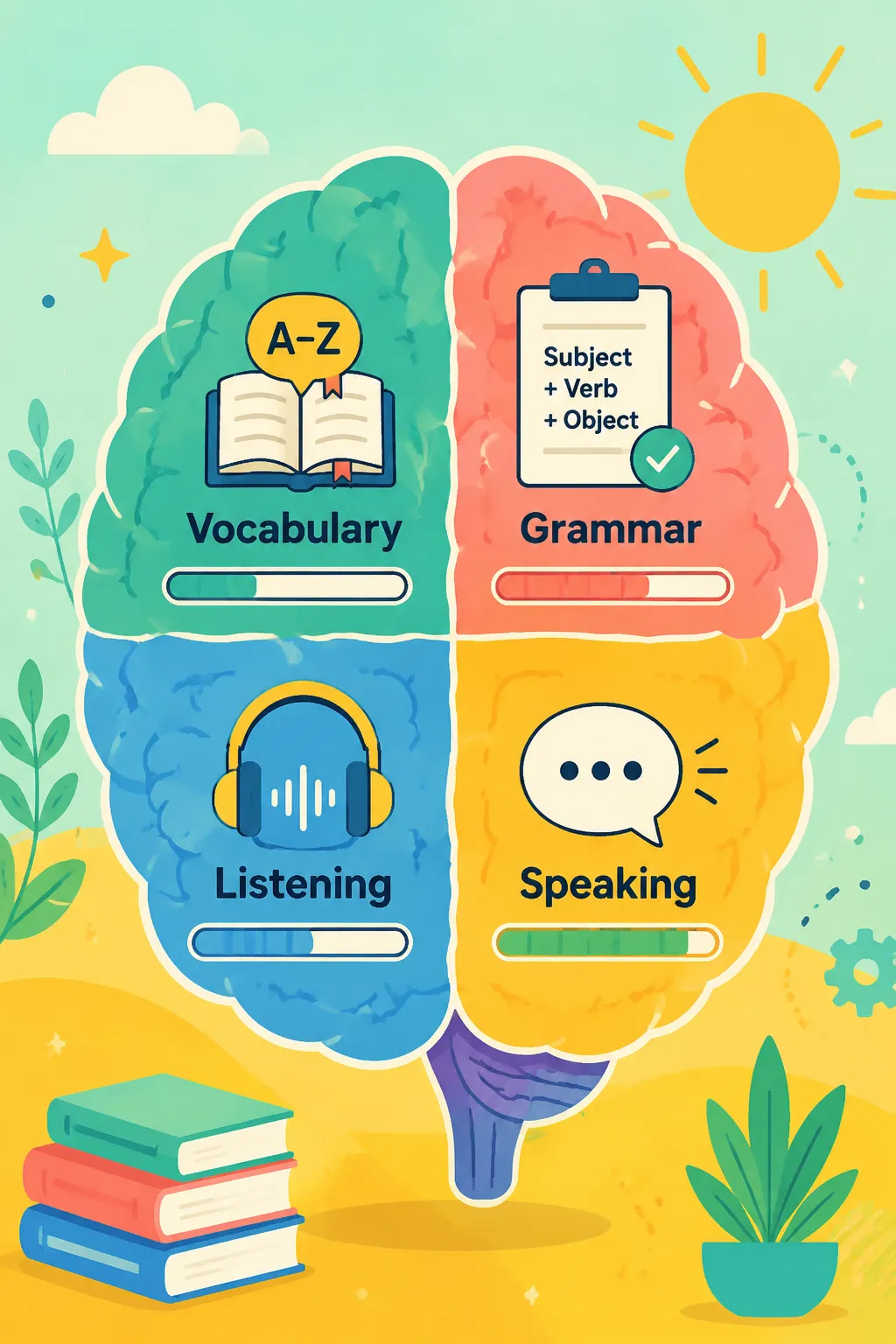
- A good Spanish language learning plan covers vocabulary, listening, speaking, and grammar in balanced daily blocks.
- Apps like Duolingo or Babbel are useful tools, but they’re not a complete plan on their own.
- Progress tracking is the single most underrated motivation tool for language learners.
Spanish Lesson Plans for Elementary Teachers and Adult Beginners: Why Structure Matters
A structured Spanish language learning plan is the difference between slow, frustrating progress and real conversational gains. Without a plan, most learners bounce between apps, YouTube videos, and phrasebooks – picking up random vocabulary but never building the grammar backbone to actually form sentences.
This applies whether you’re an adult learning for travel, work, or personal growth – or even if you’re looking at how elementary Spanish curriculum works to understand what structured learning actually looks like at its best.
The good news: Spanish is one of the most learnable languages for English speakers. According to the Foreign Service Institute, it’s a Category I language – meaning it takes significantly less time than languages like Mandarin or Arabic. That’s a real advantage you should use.
What’s your language learning style?
Answer 6 quick questions — get a personalized study path built for how you actually learn.
Can You Really Learn Spanish in 90 Days?
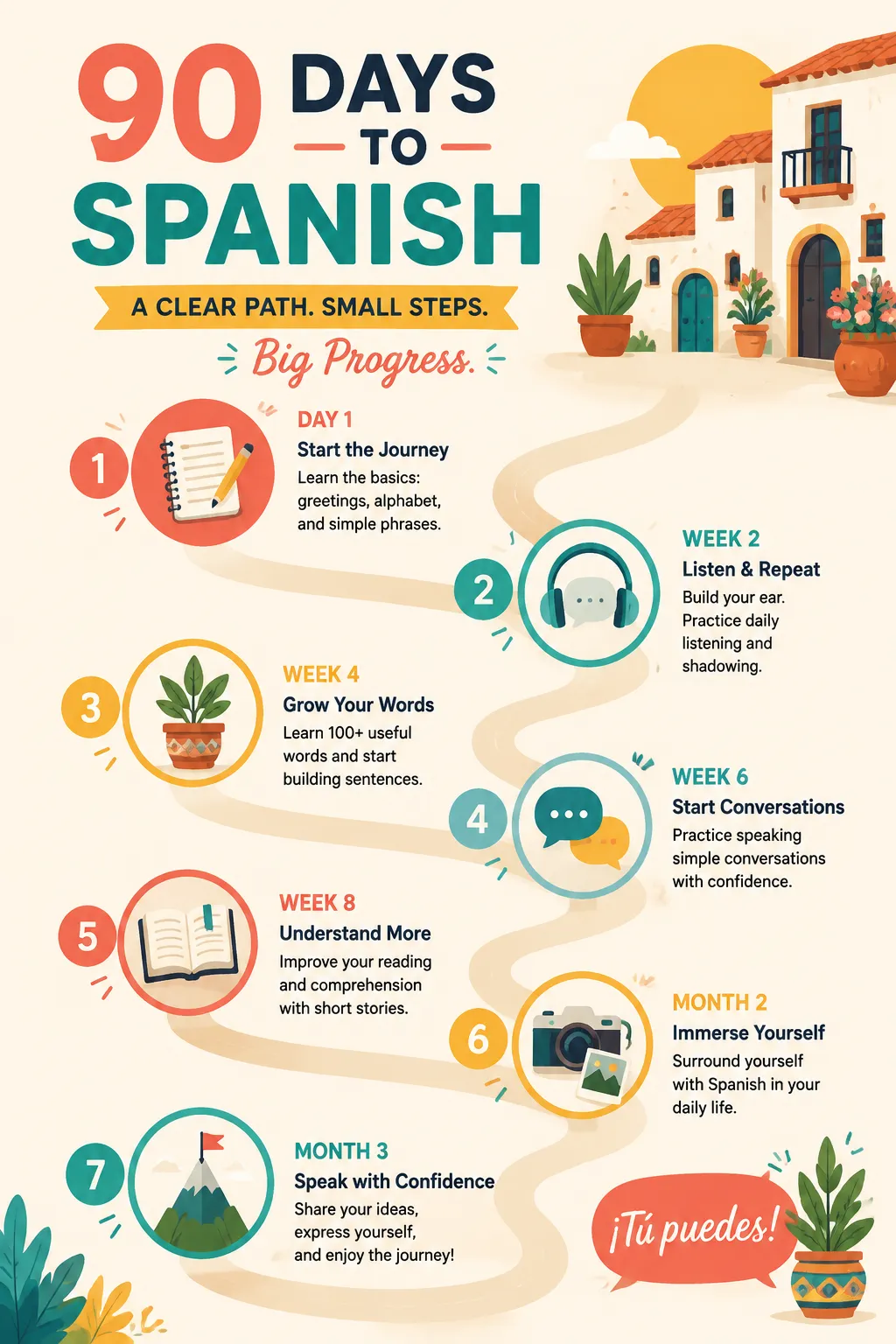
Yes – with one important clarification. In 90 days of consistent, structured practice, you can reach a solid B1 conversational level, meaning you can handle everyday conversations, travel situations, and basic work interactions. You will not be fluent in the sense of discussing philosophy or understanding rapid native speech at full speed.
The Common European Framework of Reference (CEFR) defines B1 as the ability to deal with most situations likely to arise while traveling and to describe experiences and events. That’s a genuinely useful level – and it’s achievable in 90 days if you follow a real plan.
What kills the 90-day goal for most people isn’t lack of talent. It’s inconsistency, skipping speaking practice, and switching methods every two weeks.
How Long Does It Actually Take to Speak Spanish Fluently?
Full fluency – the kind where you follow native speakers at natural speed, catch jokes, and think in Spanish – typically takes 1.5 to 3 years of consistent study for English speakers. The FSI’s 600-750 hour estimate for professional working proficiency is the most-cited benchmark in the field.
But “fluency” is a spectrum. Here’s a more honest breakdown:
- 30 days: Basic greetings, numbers, colors, survival phrases
- 90 days: Conversational B1 – travel, shopping, simple work talk
- 6 months: B2 – comfortable in most everyday situations
- 1-2 years: C1 – near-native in most contexts
The 90-day window is real and worth chasing. It just needs a plan that doesn’t burn you out in week three.
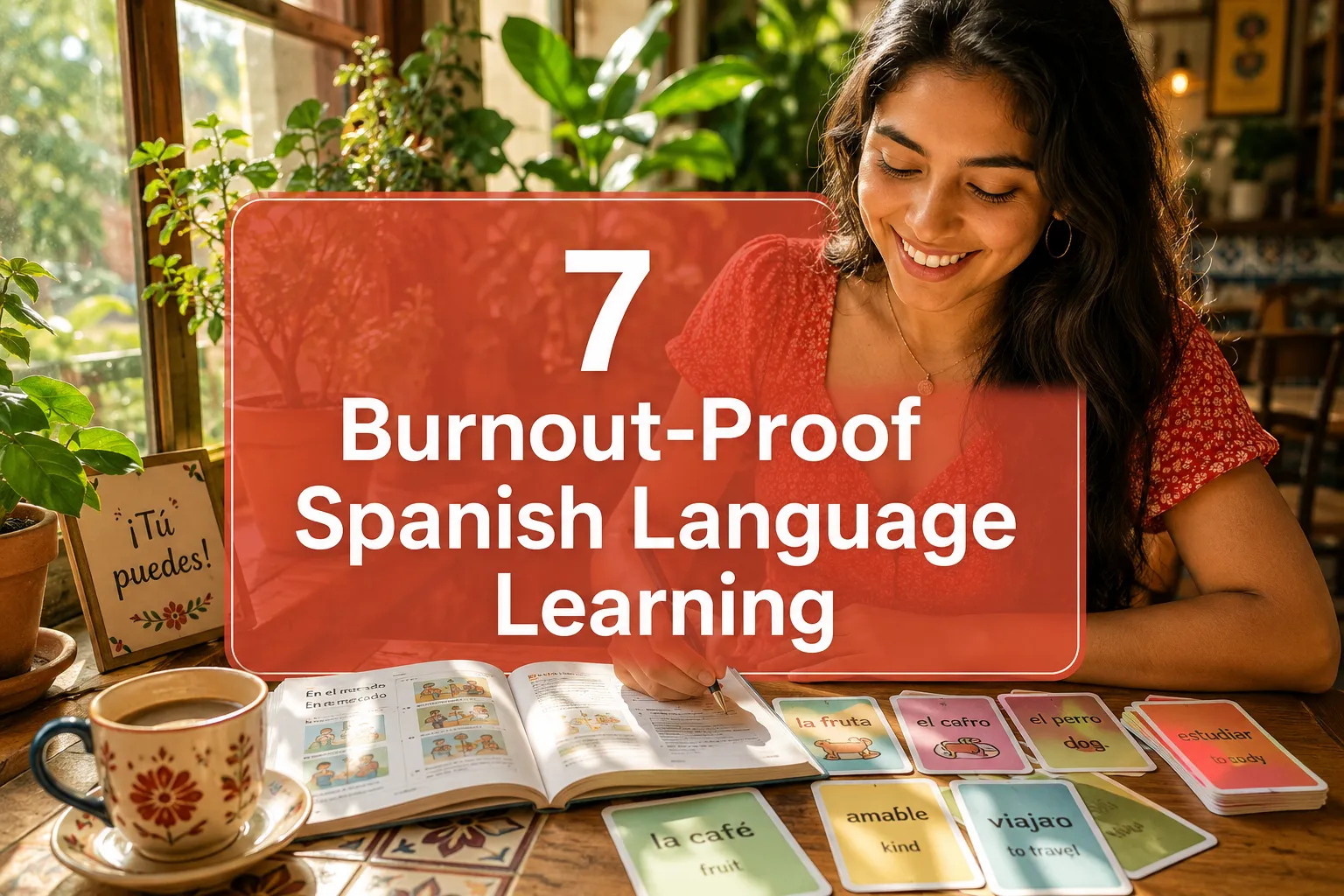
The 7-Step Spanish Language Learning Plan (Burnout-Proof)
This is the core of your Spanish language learning plan. Each step builds on the last. Don’t skip ahead.
Step 1 – Build Your Spanish Alphabet and Sound Foundation (Days 1-5)
Spanish pronunciation is consistent – once you know the sounds, you can read almost anything aloud correctly. Spend the first five days learning the Spanish alphabet, focusing on sounds that differ from English: the rolled “r,” the “j” sound, “ll,” and “ñ.”
Use Forvo – a free pronunciation database with native speaker recordings – to hear every letter sound in real context. This prevents the bad pronunciation habits that are hard to unlearn later.
Step 2 – Learn Numbers, Greetings, and Calendar Time (Days 6-14)
Numbers, greetings, and days of the week are your first vocabulary priority. They appear in almost every real conversation and give you immediate wins.
Target these first:
- Numbers 1-100
- Greetings and farewells (hola, adiós, buenos días, hasta luego)
- Days of the week and months
- Basic question words: qué, cómo, cuándo, dónde
Calendar time vocabulary – days, months, seasons – is especially useful because it comes up constantly in small talk. Sonrisas Spanish curriculum, which is widely used in elementary classrooms, starts here for a reason: these words build the scaffolding for everything else.
Step 3 – Master Core Grammar Without Overloading (Days 15-30)
Definite and indefinite articles (el, la, un, una) and present-tense verb conjugation for the 20 most common verbs are your grammar targets for month one.
Don’t try to memorize every verb form. Focus on:
- ser vs. estar (to be)
- tener (to have)
- ir (to go)
- querer (to want)
- poder (can/to be able to)
Common mistake: Learners spend weeks on grammar charts and never practice speaking those forms aloud. Grammar only sticks when you use it in sentences you care about.
Step 4 – Add 10 New Vocabulary Words Per Day Using Spaced Repetition (Days 1-90)
Anki is the gold standard for spaced repetition flashcard systems. It’s free and backed by decades of memory research. Ten new words per day means 900 words by day 90 – which covers the most common vocabulary in everyday Spanish conversation.
The Zipf frequency list shows that the top 1,000 most common Spanish words cover roughly 85% of everyday speech. You don’t need to know 10,000 words to hold a real conversation.
💡 If you want structured audio lessons alongside your flashcard practice, Rocket Languages offers a free trial that pairs well with this step – their Spanish course uses spaced repetition and native audio from day one.
Step 5 – Listen Every Single Day (Days 1-90)
Listening is the skill most beginners skip, and it’s the reason so many people “study Spanish for years” but can’t understand native speakers.
Start with:
- Language Transfer – a free audio course that builds Spanish grammar through thinking, not memorizing
- Dreaming Spanish – a YouTube channel with comprehensible input videos graded by level, from beginner to advanced
Aim for 15-20 minutes of listening daily. It doesn’t have to be active study – commute listening counts.
Step 6 – Speak From Week One, Even If It’s Terrible (Days 7-90)
This is the step most people delay, and it’s the one that matters most. Speaking activates a completely different type of memory than reading or listening. The discomfort of making mistakes is exactly what makes the language stick.
If you have no one to practice with:
- Use iTalki to book affordable community tutors for $5-15 per hour
- Try Tandem for free language exchange with native Spanish speakers
- Talk to yourself – narrate your day in Spanish out loud
For more ideas on speaking practice without a partner, check out these 9 easy Spanish tricks beginners wish they knew sooner.
Step 7 – Track Progress Weekly and Adjust (Every Sunday)
Every Sunday, spend 10 minutes reviewing the week. Ask yourself three questions:
- Did I hit my daily practice target at least 5 out of 7 days?
- Can I say something this week that I couldn’t say last week?
- What’s the one thing I’ll focus on improving next week?
Progress tracking is the most underrated motivation tool in language learning. Seeing a streak of 30 days on a habit tracker is genuinely motivating in a way that abstract goals (“I want to be fluent”) are not.

Creative Spanish Lesson Activities That Keep You Engaged
The best Spanish lesson activities are ones you’ll actually do. Boredom is a bigger enemy than difficulty.
Here are activities that work for adult learners and mirror what good elementary Spanish lesson plans use in classrooms – because the underlying learning science is the same at any age:
- Build a “Langspo” board – a physical or digital mood board of Spanish words, images, and phrases that inspire you. Pin it somewhere you see daily.
- Label objects in your home – sticky notes on furniture, appliances, and food items. Passive exposure adds up fast.
- Create illustrated flashcards – draw a simple image for each new word. The act of drawing encodes the word more deeply than just writing it.
- Use cutouts from Spanish magazines or print Spanish news headlines and circle every word you recognize.
- Integrate songs – music is one of the most powerful memory tools for language. Spotify has curated Spanish learning playlists. Songs repeat vocabulary in emotional context, which makes it stick.
- Act out vocabulary – physically mime the action or object when you review a word. This kinesthetic memory technique is used in Sonrisas Spanish classroom lessons for a reason.
- Record yourself speaking – play it back a week later. The improvement is almost always more than you expect, and it’s the clearest proof of progress you’ll get.
- Color code grammar concepts – use one color for nouns, another for verbs, another for adjectives when writing practice sentences.
These activities support every stage of your Spanish language learning plan and prevent the monotony that causes burnout.
Spanish Learning Apps vs. Classes: Which Is Better?
Apps and classes serve different purposes, and neither is a complete Spanish language learning plan on its own. Apps like Duolingo are excellent for daily habit-building and vocabulary review, but studies on app-only learning – including a 2020 study published in Language Learning & Technology – show they produce limited speaking ability without supplementary conversation practice.
Classes (in-person or online) provide accountability, real-time feedback, and speaking practice that apps can’t replicate. But they’re expensive and often move at a pace that doesn’t match your schedule.
The best approach combines both:
| Tool | Best For | Weakness |
|---|---|---|
| Duolingo / Babbel | Daily habit, vocabulary | No real speaking practice |
| iTalki tutors | Speaking, feedback | Cost, scheduling |
| Anki | Vocabulary retention | Requires self-discipline |
| Language Transfer | Grammar intuition | Audio-only, no visuals |
| Dreaming Spanish | Listening comprehension | Passive if overused |
💡 Rocket Languages bridges the gap well – it combines structured lessons with audio-based speaking practice. Try it free here and see if it fits your learning style before committing.
How Much Time Per Day Do You Need to Learn Spanish?
30 minutes of focused, daily practice is the minimum effective dose for real progress. Research on spaced learning, including work cited by Cambridge University Press language acquisition studies, consistently shows that daily short sessions outperform longer but infrequent study blocks.
Here’s a realistic daily schedule for a busy learner:
- 10 min: Anki flashcard review (vocabulary)
- 10 min: Listening (Language Transfer or Dreaming Spanish)
- 10 min: Speaking practice or writing sentences
That’s it. On days you have more time, add a 20-minute iTalki session or a longer Dreaming Spanish video. But never skip the 30-minute minimum.
For people building a language learning plan as a complete beginner, the daily consistency principle applies across every language – not just Spanish.
What’s your language learning style?
Answer 6 quick questions — get a personalized study path built for how you actually learn.
How to Stay Motivated Learning Spanish Long Term
Motivation follows action, not the other way around. The learners who succeed don’t wait to feel motivated – they build systems that make showing up easy even on low-energy days.
Practical strategies that work:
- Attach Spanish to an existing habit – practice during your morning coffee, commute, or lunch break
- Set a 90-day goal with a specific reward – book a trip, plan a Spanish-language movie marathon, or schedule a call with a native speaker
- Join a community – Reddit’s r/learnspanish has 900,000+ members and is genuinely supportive
- Use the “never miss twice” rule – missing one day is fine; missing two in a row starts a slide
- Celebrate small wins – the first time you understand a sentence in a Spanish podcast without pausing, write it down
The Sonrisas Spanish methodology used in elementary classrooms builds calendar time rituals and songs into every lesson specifically because routine and emotional engagement are the two strongest predictors of retention. The same principle applies to adult learners.
Most Common Mistakes People Make Learning Spanish
Most Spanish learners make the same five mistakes. Knowing them in advance saves months of wasted time.
- Passive studying only – reading and watching without ever speaking or writing
- Switching methods constantly – trying a new app every two weeks instead of going deep on one system
- Avoiding mistakes – waiting until grammar is “perfect” before speaking
- Ignoring listening – focusing only on vocabulary and grammar, then being unable to understand native speakers
- No clear plan – bouncing between random YouTube videos, apps, and phrasebooks with no structure
A ready-to-use Spanish lesson plan or structured curriculum solves most of these by default. Structure removes decision fatigue and keeps you moving forward.
How to Practice Spanish Speaking When You Have No One to Talk to
You don’t need a conversation partner to build speaking skills – you need output practice. Speaking to yourself, recording yourself, and using AI conversation tools are all legitimate methods.
Specific tactics:
- Shadow native speakers – play a Spanish audio clip, pause it, and repeat the sentence immediately, matching rhythm and intonation
- Use ChatGPT or Claude as a conversation partner – type or speak in Spanish, ask for corrections
- Narrate your day out loud in Spanish – “Estoy haciendo café. Necesito ir al trabajo.”
- Book a community tutor on iTalki for $5-10/hour – even once a week makes a significant difference
If you’re curious how this compares to learning other languages from scratch, the step-by-step guide to learning Korean uses similar speaking-from-day-one principles and is worth reading for the methodology alone.
Cheapest Way to Learn Spanish Effectively
A complete, effective Spanish language learning plan can cost under $10 per month – or even nothing. The free tools available in 2026 are genuinely excellent.
Free tools that work:
- Language Transfer – completely free, no ads, donation-supported
- Anki – free on desktop, one-time $25 on iOS (worth it)
- Dreaming Spanish – free YouTube channel with 1,000+ hours of content
- Duolingo – free tier is sufficient for daily habit-building
- Tandem – free language exchange
Low-cost paid options:
- iTalki community tutors: $5-15/hour
- Babbel subscription: around $7/month
- Rocket Languages: one-time purchase with a free trial available
The Language Transfer course for Spanish is particularly underrated – it’s 40 audio lessons that build grammatical intuition rather than memorization, and it’s completely free.
What Level of Spanish Can You Reach in 90 Days?
With 30-45 minutes of daily practice following a structured plan, most adult beginners reach CEFR A2 to B1 in 90 days. A2 means you can handle simple, familiar topics and routine exchanges. B1 means you can navigate travel, describe experiences, and hold basic conversations on familiar subjects.
The CEFR framework is the international standard for measuring language ability. B1 is genuinely useful – it’s enough to travel confidently, make friends, and handle basic work situations in Spanish-speaking countries.
To self-assess your level, use the free DELE practice tests from Instituto Cervantes, or take a placement test on Babbel or Duolingo.
Is Immersion or Classroom Better for Learning Spanish?
Immersion is more effective for speaking and listening, but only if you have enough foundation to understand what’s happening around you. Classroom or structured learning builds that foundation faster. The research, including work from Stephen Krashen’s input hypothesis, suggests that comprehensible input – material just above your current level – is the most efficient driver of language acquisition.
The practical answer for most people: use structured lessons (classroom, app, or curriculum) for the first 30-60 days to build vocabulary and grammar, then shift toward immersion-heavy practice – Spanish podcasts, movies, music, and conversation – as your comprehension grows.
A Spanish language learning plan pdf template can help you map out this transition week by week.
When Spanish Lesson Plans Are Not Enough
A Spanish lesson plan gives you structure, but structure alone doesn’t produce fluency. The missing ingredient is almost always emotional investment – a real reason to speak Spanish that matters to you personally.
The learners who reach B1 in 90 days aren’t necessarily the most disciplined. They’re the ones who have a trip booked, a family member to call, a job requirement, or a personal challenge they’ve committed to publicly.
If you’re finding that your Spanish language learning plan feels mechanical, ask yourself: what would I actually do with Spanish if I had it right now? Then build your practice around that answer.
💡 For learners who want a structured, audio-first program that keeps motivation high through real conversation practice, Rocket Languages’ free trial is worth exploring – it’s one of the few programs that combines grammar, culture, and speaking in a single curriculum.
FAQs About Spanish Lesson Plans for Elementary Teachers and Learners
What should a first Spanish lesson plan include?
A first Spanish lesson plan should cover the Spanish alphabet and pronunciation, basic greetings and farewells, numbers 1-20, and one or two simple sentence structures. The goal is immediate usability – learners should leave the first lesson able to introduce themselves and exchange basic pleasantries in Spanish.
How do I teach Spanish to absolute beginners?
Start with high-frequency vocabulary: greetings, numbers, colors, and common objects. Use repetition, songs, and physical activities to reinforce new words. Avoid heavy grammar explanations in the first few lessons – focus on getting students to produce and respond to Spanish in context. Sonrisas Spanish curriculum uses this approach effectively in elementary classrooms.
What makes a good Spanish lesson plan?
A good Spanish lesson plan has a clear objective, builds on prior vocabulary, includes listening and speaking practice (not just reading), and uses varied activities to maintain engagement. It should also include a brief review of previous material at the start and a way to check understanding at the end.
Where can I get beginner Spanish lesson plans?
Free beginner Spanish lesson plans are available through Teachers Pay Teachers, the Sonrisas Spanish curriculum (which offers sample materials), and Fluent in 3 Months. For a complete classroom-ready Spanish curriculum, Sonrisas Spanish provides structured materials for elementary teachers. Adult learners can use Language Transfer or Rocket Languages as ready-to-use Spanish lesson frameworks.
What is the 80/20 rule for learning Spanish?
The 80/20 rule for learning Spanish means that 20% of Spanish vocabulary and grammar covers 80% of everyday communication. Specifically, the most common 1,000 Spanish words account for roughly 85% of spoken language. Focusing your Spanish language learning plan on high-frequency vocabulary and core verb conjugations before tackling advanced grammar gives you the fastest path to real conversation.
What is the 80/20 rule in Spanish?
In Spanish learning, the 80/20 rule (Pareto Principle) suggests that a small core of vocabulary and grammar patterns – around 1,000-2,000 words and 10-15 key verb structures – covers the vast majority of real-world Spanish communication. Rather than trying to learn everything, a smart Spanish language learning plan prioritizes these high-return items first and adds complexity only after the core is solid.
What is a good roadmap for learning Spanish?
A good Spanish learning roadmap follows this sequence: pronunciation and alphabet (week 1), core vocabulary and greetings (weeks 1-2), basic grammar and present tense verbs (weeks 2-4), conversational practice with a tutor or language partner (month 2), listening immersion through podcasts and videos (ongoing), and regular speaking output from week one. Resources like the Dreaming Spanish language learning roadmap and Language Transfer course for Spanish are excellent free guides to follow.
Can I master Spanish in 3 months?
You cannot reach full mastery in 3 months, but you can reach solid conversational ability (CEFR B1) in 90 days with 30-45 minutes of daily practice. “Mastery” – the ability to discuss complex topics, understand rapid native speech, and use advanced vocabulary naturally – takes 1.5 to 3 years for most English speakers. The 3-month goal is realistic for functional, confident everyday conversation, not professional or academic fluency.
Conclusion: Start Strong with Spanish Lesson Plans That Work
The biggest barrier to speaking Spanish isn’t talent, time, or money. It’s starting without a plan and quitting when the initial excitement fades.
A burnout-proof Spanish language learning plan works because it’s built around daily minimums you can actually hit, speaking practice from day one, and progress you can see and measure. The 7 steps in this guide are designed to get you to real conversation in 90 days – not perfect Spanish, but useful, confident, everyday Spanish.
Your action steps for today:
- Download Anki and add your first 10 Spanish words
- Listen to the first Language Transfer lesson (it’s 10 minutes)
- Say one Spanish sentence out loud before you go to sleep tonight
That’s it. The plan works if you work it. For more Spanish-specific tips and resources, explore The Fluent Professor’s Spanish lessons – and if you want a complete audio-based program to complement this plan, check out the Fluent Professor homepage for additional resources.
Buena suerte. You’ve got this.