
Last updated: August 2, 2026
Quick Answer: Learning Spanish as a beginner doesn’t have to be slow or painful. The fastest path is to start with a small, strategic vocabulary, use short daily sessions, and speak out loud from day one – even if you’re alone. Most beginners see real progress within 4 to 8 weeks when they use the right methods consistently.
Key Takeaways
- Start with the 100-200 most common Spanish words, not random vocabulary lists
- Short daily sessions (20-30 minutes) beat long weekly study marathons every time
- Speaking out loud from day one – even to yourself – builds confidence fast
- Spaced repetition apps like Anki help you remember words far longer than regular flashcards [3]
- Present tense alone lets you hold basic conversations before you touch complex grammar
- Duolingo is a great starting point but works best when combined with other tools
- Free resources can get you to conversational level – paid courses add structure and speed
- Adults learn Spanish just as well as children when they use the right strategies
- The biggest beginner mistake is trying to learn everything at once
- The first 300 Spanish words cover roughly 65% of everyday spoken conversation (estimate based on general frequency linguistics research)
What’s the Easiest Way to Start Learning Spanish as a Complete Beginner
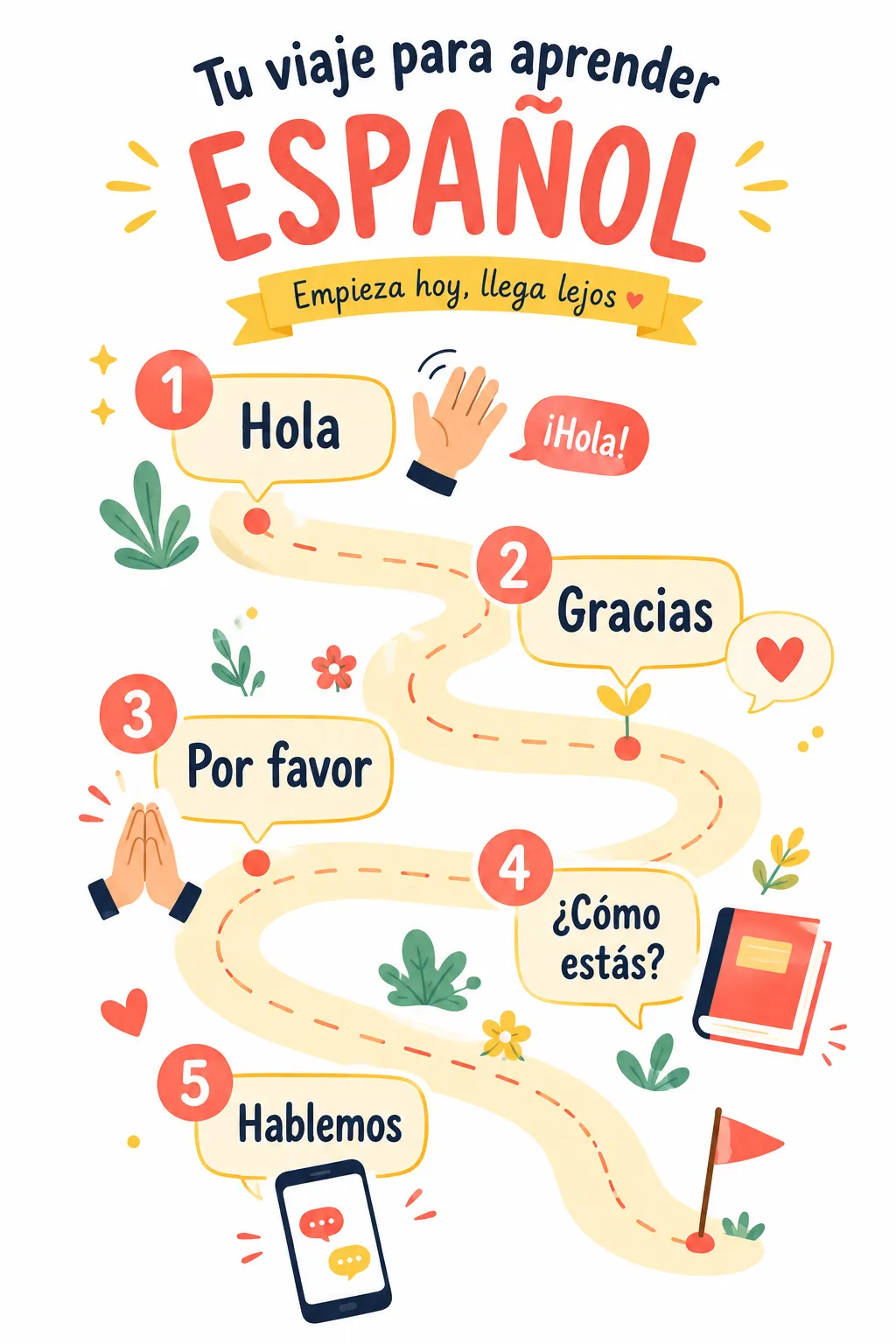
The easiest way to start is to build a tiny “strategic vocab bank” of the 100 most common Spanish words first. Don’t open a grammar textbook on day one. Instead, learn words you’ll actually use – greetings, numbers, common verbs, and everyday nouns.
Here’s a simple starter plan for week one:
- Day 1-2: Learn 10 basic greetings and introductions (Hola, Buenos días, ¿Cómo estás?)
- Day 3-4: Add 10 common verbs (ser, tener, querer, ir, comer)
- Day 5-6: Learn 10 everyday nouns (casa, agua, comida, trabajo, amigo)
- Day 7: Review everything using a free flashcard app
This approach works because your brain connects new words to things you already care about. Random vocabulary lists, on the other hand, feel like homework and get dropped fast.
Choose this if: You’ve never studied Spanish before and want to build momentum quickly without feeling overwhelmed.
“The first 100 words you learn in Spanish should be the 100 most useful ones – not the 100 easiest ones.”
What Should Beginners Learn First in Spanish
Beginners should learn present tense verbs, basic greetings, and clean pronunciation before anything else. These three things together let you have a real (if simple) conversation within weeks.
The beginner priority order:
- Greetings and polite phrases
- Numbers 1-20
- Present tense of 10 core verbs
- Basic question words (qué, dónde, cuándo, cómo, quién)
- Common nouns for daily life (food, places, family, time)
Spanish phrases beginners should learn first:
| Spanish | English |
|---|---|
| Hola / Buenos días | Hello / Good morning |
| ¿Cómo te llamas? | What’s your name? |
| Me llamo… | My name is… |
| ¿Cuánto cuesta? | How much does it cost? |
| No entiendo | I don’t understand |
| ¿Puede repetir? | Can you repeat that? |
| Gracias / De nada | Thank you / You’re welcome |
| Por favor | Please |
Common mistake: Many beginners skip pronunciation and focus only on reading Spanish. This creates a gap where you can read a sentence but can’t say it or understand it when spoken. Fix this early by listening to native audio from day one.
How to Learn Spanish for Beginners Easy – The 9 Tricks That Actually Work
These nine tricks are the shortcuts most beginners only discover after months of frustration. Using them from the start saves serious time.
Trick 1: Build a Strategic Vocab Bank First
Pick the top 200 most frequent Spanish words and learn those before anything else. Apps like Anki let you download pre-made frequency decks so you don’t have to build your own list.
Trick 2: Master Present Tense Before Complex Grammar
Present tense covers the vast majority of everyday conversation. Lock it in solidly before you even look at past or future tense. Clean pronunciation matters here too – practice saying each verb out loud, not just writing it.
Trick 3: Use Short, Consistent Sessions
Twenty to thirty minutes every day beats a three-hour session once a week. Your brain consolidates language during sleep, so daily exposure creates much stronger memory traces. [9]
Trick 4: Start Speaking with Mini Routines
Narrate your morning out loud in Spanish. Say “Voy a tomar café” (I’m going to drink coffee) while you make breakfast. These mini speaking routines build real fluency faster than any app alone.
Trick 5: Use Spaced Repetition for Vocabulary
Spaced repetition systems (SRS) show you a word right before you’re about to forget it. Research shows this method dramatically improves long-term retention compared to regular review. [7] Apps like Anki and Duolingo both use this approach. [3]
Trick 6: Watch Spanish Content with Subtitles
Start with Spanish subtitles on shows you already know well. Your brain fills in meaning from context, and you absorb natural speech patterns without feeling lost.
Trick 7: Label Your Home in Spanish
Put sticky notes on objects around your house – “la puerta” on the door, “la ventana” on the window. Passive exposure throughout the day reinforces vocabulary without extra study time.
Trick 8: Find a Language Exchange Partner
Apps like Tandem or HelloTalk connect you with native Spanish speakers who want to learn English. You each practice the other’s language. It’s free, it’s real conversation, and it’s motivating.
Trick 9: Track Your Progress Weekly
Write down 5 things you can say in Spanish that you couldn’t say last week. Seeing growth keeps you going when motivation dips.
Best Spanish Learning Apps for Beginners That Actually Work
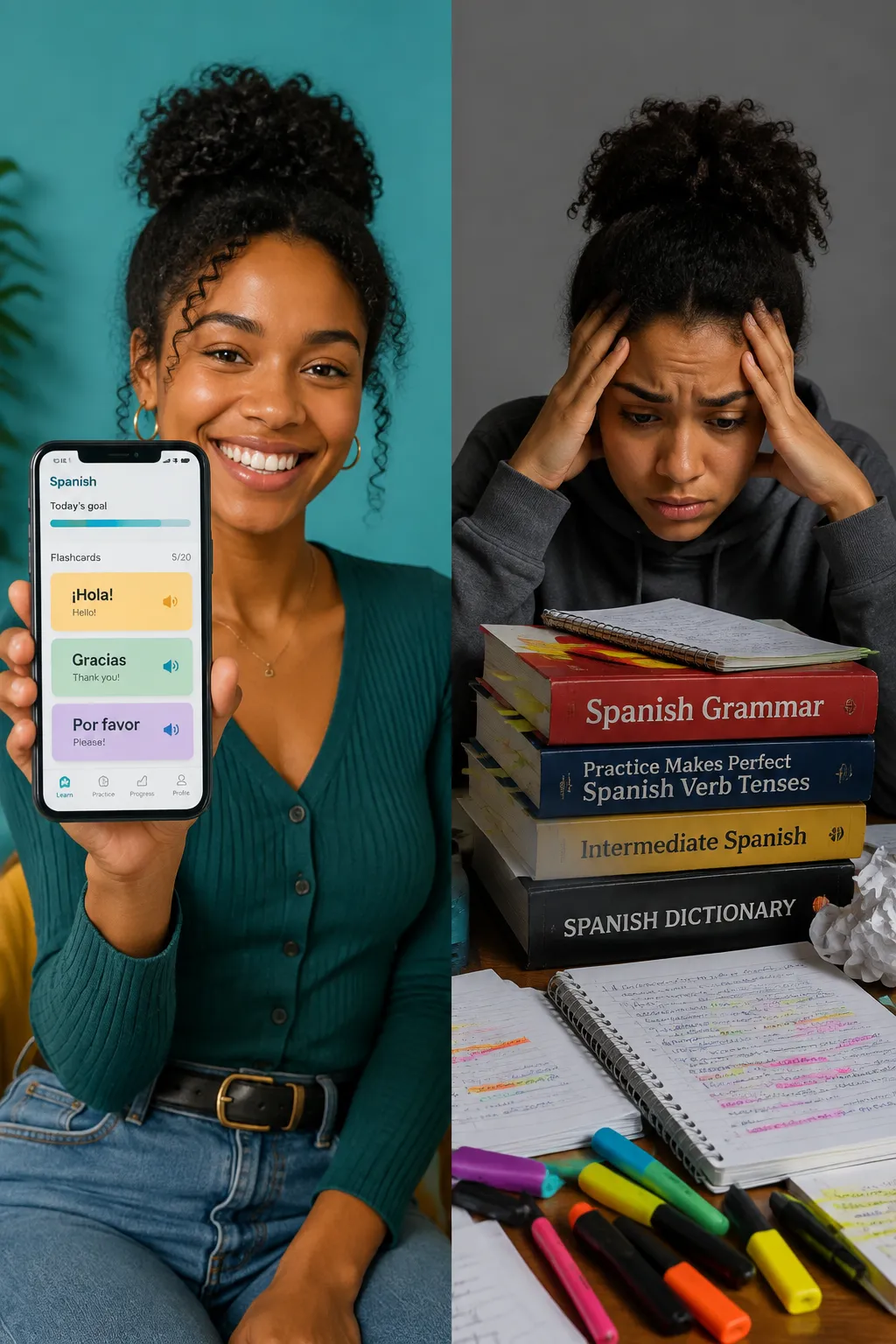
The best apps for beginners are Duolingo, Anki, and Pimsleur – each serving a different purpose. Duolingo builds habits, Anki builds vocabulary retention through spaced repetition [6], and Pimsleur builds listening and speaking skills.
App breakdown by goal:
- Duolingo – Best for daily habit building and gamified practice. Free tier is solid.
- Anki – Best for vocabulary retention using spaced repetition. Free on desktop, paid on iOS. [10]
- Pimsleur – Best for audio-focused learners who want to speak quickly. Paid subscription.
- Babbel – Best for structured grammar lessons with real-world context. Paid.
- HelloTalk – Best for free conversation practice with native speakers. Free with premium option.
Is Duolingo enough to learn Spanish, or do I need more?
Duolingo alone won’t get you to conversational fluency, but it’s an excellent foundation. It works best as one part of a broader routine. Pair it with Anki for vocabulary and HelloTalk or a tutor for speaking practice, and you’ll progress much faster than with any single app.
How Long Does It Take to Learn Basic Spanish
Most beginners can hold a simple conversation in Spanish within 3 to 6 months of consistent daily practice. “Basic Spanish” – meaning you can introduce yourself, order food, ask for directions, and handle everyday situations – is achievable faster than most people think.
The U.S. Foreign Service Institute (FSI) classifies Spanish as a Category I language for English speakers, meaning it’s among the easier languages to learn. Their estimates suggest roughly 600-750 classroom hours to reach professional working proficiency – but basic conversational Spanish takes far less time than that.
Realistic timeline for beginners:
- 2-4 weeks: Learn greetings, numbers, and 100 core words
- 1-3 months: Hold simple conversations, understand slow speech
- 3-6 months: Navigate everyday situations with confidence
- 6-12 months: Understand TV shows, read simple articles, chat comfortably
What speeds this up: Daily practice, speaking out loud, and using spaced repetition. [9]
What slows it down: Inconsistent study, skipping speaking practice, and trying to master grammar before building vocabulary.
How to Learn Spanish Fast Without Getting Overwhelmed
The key to learning Spanish fast without burning out is to narrow your focus ruthlessly. Pick one resource, one method, and one daily time slot – and stick to it for 30 days before adding anything new.
Beginners often overwhelm themselves by downloading five apps, buying two textbooks, and signing up for a YouTube channel all in the same week. The result is decision fatigue and zero progress.
A simple anti-overwhelm framework:
- Pick one app (Duolingo or Babbel) for your daily habit
- Add one vocabulary tool (Anki with a frequency deck)
- Add speaking practice only after week two
- Add listening input (a podcast or show) after week four
Give each layer two weeks before adding the next. This stacking approach builds momentum without chaos.
Spanish learning hacks that save time:
- Learn cognates first – Spanish and English share thousands of words (hospital, animal, natural, important). These are free vocabulary points.
- Use the 80/20 rule – 20% of Spanish words cover 80% of everyday speech. Focus there.
- Record yourself speaking and play it back. You’ll catch errors you’d never notice otherwise.
- Set your phone language to Spanish. Passive exposure adds up fast.

How to Practice Spanish Speaking When You’re Alone
You can practice Spanish speaking alone by narrating your daily activities out loud, using language exchange apps, talking to AI chatbots in Spanish, or recording yourself. Speaking practice doesn’t require another person – it requires your voice.
Solo speaking methods that work:
- Self-talk narration: Describe what you’re doing as you do it. “Estoy preparando el desayuno” (I’m making breakfast).
- Shadowing: Play a native speaker audio clip and repeat exactly what they say, mimicking rhythm and pronunciation.
- Voice journaling: Record a 1-minute Spanish audio diary each evening. Listen back the next day.
- AI conversation practice: Tools like ChatGPT or Duolingo’s AI tutor let you type or speak in Spanish and get corrections.
- Mirror practice: Talk to yourself in a mirror. It feels silly but builds confidence for real conversations.
Even 5 minutes of speaking out loud daily makes a noticeable difference within two weeks.
Common Mistakes Beginners Make When Learning Spanish
The most common mistake is waiting until you “know enough” to start speaking. Most beginners spend months studying and never open their mouths – then wonder why they freeze up in real conversations.
Top 7 beginner mistakes:
- Studying grammar before building vocabulary – Grammar rules feel meaningless without words to apply them to
- Using only one resource – No single app or book covers everything
- Skipping pronunciation practice – Bad habits formed early are hard to break
- Studying in long, infrequent sessions – Your brain needs regular exposure, not occasional marathons
- Translating word-for-word in your head – Train yourself to think in Spanish phrases, not translated English
- Ignoring listening practice – Reading Spanish and understanding spoken Spanish are very different skills
- Quitting after a plateau – Progress isn’t linear. Plateaus are normal and temporary.
Best Spanish learning methods for people who hate grammar:
Skip formal grammar study entirely at first. Instead, learn phrases as complete chunks. “¿Puedes ayudarme?” (Can you help me?) works perfectly even if you don’t know why “puedes” is conjugated that way. Grammar understanding comes naturally after enough exposure.
Free vs Paid Spanish Courses for Beginners – Which Is Better
Free resources can absolutely get you to conversational Spanish. Paid courses add structure, accountability, and faster progress – but they’re not required. The right choice depends on your learning style and budget.
Free options that genuinely work:
- Duolingo (app) – habit building and gamified practice
- Anki (desktop) – spaced repetition vocabulary [6]
- YouTube channels like Dreaming Spanish – comprehensible input for all levels
- SpanishPod101 (free tier) – audio lessons with transcripts
- Language exchange via HelloTalk or Tandem
When paid courses are worth it:
- You want a structured curriculum with clear progression
- You need accountability (live classes, homework, a teacher)
- You’ve tried free resources and keep losing motivation
- You want to reach a specific level by a specific date
Bottom line: Start free. If you’re still consistent after 60 days, consider investing in a paid course or tutor to accelerate your progress.
Is It Too Late to Learn Spanish as an Adult
No, it is not too late to learn Spanish as an adult. Adults actually have several advantages over children – larger existing vocabularies to connect new words to, better study strategies, and stronger motivation.
The idea that adults can’t learn languages well is a myth. Children acquire language through years of immersion. Adults can use deliberate study strategies to compress that timeline significantly.
Research published in linguistics and applied language learning journals consistently shows that adult learners reach conversational proficiency at comparable rates to younger learners when using structured methods. [2]
Adult advantages in language learning:
- You can study intentionally, not just absorb passively
- You already understand grammar concepts from your native language
- You can use apps, podcasts, and structured resources effectively
- You have real-world motivation (travel, work, family) that drives consistency
The one area where children have an edge: Accent acquisition. Starting Spanish before age 12 tends to produce a more native-like accent. But accent is not fluency, and a slight accent never stops communication.
Spanish Learning Tips That Actually Stick in Your Brain
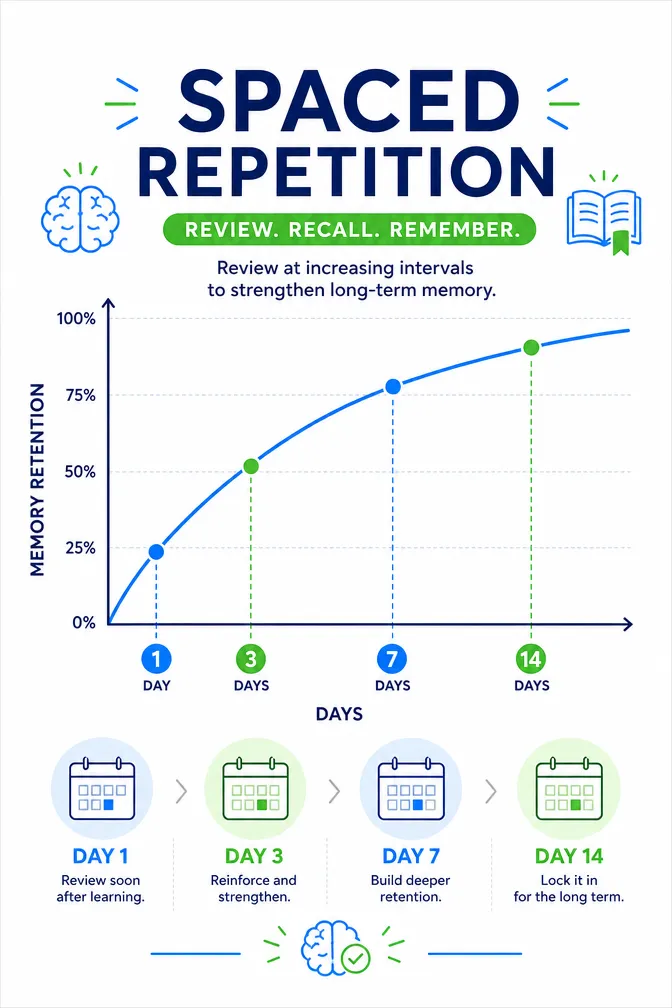
The tips that stick are the ones tied to emotion, repetition, and real use. Spaced repetition is the most scientifically supported method for long-term vocabulary retention. [7]
Why spaced repetition works:
When you review a word right before you’d naturally forget it, your brain rebuilds the memory stronger each time. [9] Over several review cycles, the word moves from short-term to long-term memory. Apps like Anki automate this process so you don’t have to track it manually. [3]
Other retention boosters:
- Use new words in sentences – Don’t just memorize “rojo means red.” Say “Mi coche es rojo” (My car is red).
- Connect words to images – Visualize a vivid image when learning a new word. The stranger the image, the better it sticks.
- Teach what you learn – Explain a Spanish concept to a friend (or even to yourself). Teaching forces deeper processing.
- Review before sleep – Studying vocabulary in the 30 minutes before bed takes advantage of sleep consolidation.
How to learn Spanish for beginners easy – the memory principle:
The brain remembers things that are repeated, emotional, or surprising. Make your Spanish study sessions active, not passive. Say words out loud, use them in sentences, and connect them to real moments in your life.
Conclusion – Your Next Steps Start Today
Learning Spanish as a beginner is genuinely more accessible in 2026 than it’s ever been. The tools are free, the methods are proven, and the community of learners is massive.
Here’s your action plan for the next 7 days:
- Today: Download Duolingo or Anki and complete your first 10-minute session
- Day 2: Learn 10 essential Spanish phrases from the table above
- Day 3: Add self-talk narration to your morning routine (even 5 minutes counts)
- Day 4: Watch one YouTube video in Spanish with subtitles
- Day 5: Review your vocabulary using spaced repetition
- Day 6: Find a language exchange partner on HelloTalk
- Day 7: Write down 5 things you can now say in Spanish that you couldn’t last week
The biggest secret about how to learn Spanish for beginners easy? Start smaller than you think you need to. Five minutes a day beats zero minutes a day by an infinite margin. Build the habit first, then build the skill.
You don’t need to be talented. You need to be consistent. 🇪🇸
FAQ
Q: Can I learn Spanish in 30 days?
You can learn basic phrases and around 200-300 words in 30 days with daily practice. Full conversational ability takes longer – typically 3 to 6 months of consistent study.
Q: What’s the best free app to learn Spanish?
Duolingo is the most popular free option for habit building. Anki (free on desktop) is the best free tool for vocabulary retention through spaced repetition.
Q: How many Spanish words do I need to know to have a basic conversation?
Around 300-500 words covers the majority of everyday conversation. Focus on high-frequency words first rather than trying to build a large vocabulary quickly.
Q: Is Spanish hard to learn for English speakers?
Spanish is considered one of the easier languages for English speakers. The grammar is more regular than English, pronunciation is consistent, and thousands of words are similar to English cognates.
Q: How do I stay motivated when learning Spanish gets hard?
Track small wins weekly, connect with other learners online, and remind yourself of your real-world reason for learning. Motivation follows progress – so keep sessions short enough that you always finish feeling good, not drained.
Q: Should I learn Latin American Spanish or Spain Spanish?
Either works. The differences are mostly accent and a handful of vocabulary words. Pick the variety that matches your goal – if you plan to travel to Mexico or South America, go with Latin American Spanish.
Q: Can I learn Spanish just by watching TV shows?
TV shows alone won’t build your Spanish, but they’re a powerful supplement. Pair passive watching with active vocabulary study and speaking practice for real results.
Q: What’s the difference between learning Spanish with an app vs a tutor?
Apps build habits and vocabulary at your own pace. A tutor gives you real conversation practice, personalized feedback, and accountability. Combining both is the fastest approach.
Q: Do I need to learn Spanish grammar rules explicitly?
Not at first. Learning phrases as chunks and getting lots of input naturally internalizes grammar patterns. Explicit grammar study becomes more useful at intermediate level.
Q: How often should I practice Spanish each day?
20 to 30 minutes daily is the sweet spot for most beginners. Consistency matters far more than session length.
References
[3] Spaced Repetition Language Learning – https://www.polychatapp.com/blog/spaced-repetition-language-learning
[6] Elevate Your Vocabulary Proven Flashcard And Spaced Repetition Techniques For Language Classes – https://www.polyglottistlanguageacademy.com/language-culture-travelling-blog/2025/2/2/elevate-your-vocabulary-proven-flashcard-and-spaced-repetition-techniques-for-language-classes
[7] Spaced Repetition – https://www.busuu.com/en/languages/spaced-repetition
[9] Spaced Repetition For Language Learning Guide – https://www.sciencebasedlearning.com/blog/spaced-repetition-for-language-learning-guide
[10] Spaced Repetition For Language Learning – https://plurilingualism.com/spaced-repetition-for-language-learning/
[2] digibug.ugr.es – https://digibug.ugr.es/handle/10481/105439